

Editorial guide
How to understand the Quran in Arabic: a step-by-step plan
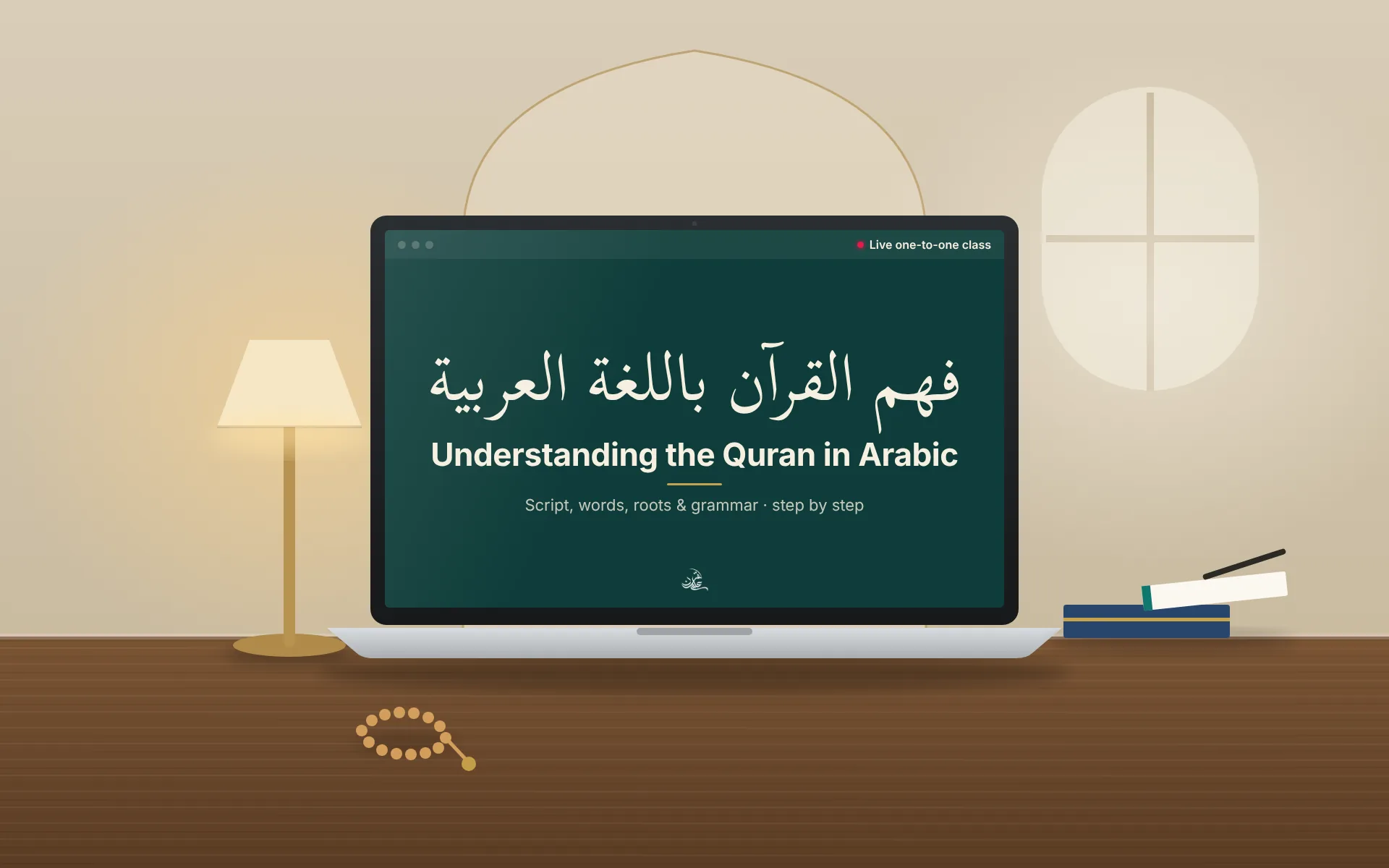
How to learn Quranic Arabic online, step by step: script, common Quranic words, roots, essential grammar, word-by-word reading, then tafsir for context.
- Live one-to-one classes
- Starting point confirmed in a free assessment
- Male or female teachers, matched where available
- Clear next-step course pages
Who this guide is for
Adults who recite but do not understand
You read the Quran already and want the words to start making sense.
Complete beginners to Arabic
You want a clear order of study before choosing a course.
Parents planning for older children
You want a realistic map for a teenager who is ready for meaning.
The step-by-step plan
- 1Read the script first: letters, vowel marks and joined words, so you can read any verse.
- 2Learn high-frequency Quranic vocabulary: the words and phrases that come up again and again.
- 3Study roots and word patterns: how three root letters build families of related words.
- 4Cover essential grammar: verbs, pronouns and particles, the pieces that join a sentence together.
- 5Read with a word-by-word translation: short surahs first, checking each word you know.
- 6Add tafsir for context: why verses were revealed and how scholars explained them.
Step 1: Read the script first
You cannot study Quranic words if you cannot read them. Comfortable reading of letters, vowel marks and joined forms comes first.
If letters are still new, a primer such as Noorani Qaida builds this foundation. Learners who already read can move straight on.
Step 2: Learn the words that repeat most
Many Quranic words repeat often. Names of Allah, words for believing, the Hereafter, and common particles appear in surah after surah.
Learning these common words early pays off quickly. Each one you master helps you recognise meaning in many verses at once.
Keep a small notebook or flashcards. Review a few words daily rather than many words once a week.
Step 3: Roots and word patterns
Most Arabic words grow from a root of three letters. The root k-t-b, for example, carries the idea of writing.
From that root come kitab (book), katib (writer) and maktub (written). The root gives the core meaning; the pattern adds the detail.
Once you know common patterns, an unfamiliar word often becomes guessable. This is one of the most rewarding stages of study.
Step 4: Essential grammar
You do not need every rule of Arabic grammar to begin. Focus on what unlocks Quranic sentences most often.
- Verbs: past and present forms, and who is doing the action
- Pronouns: attached and separate forms, such as “he”, “they” and “you”
- Particles: small words like “in”, “from”, “not” and “indeed”
- Basic sentence types: nominal and verbal sentences
Step 5: Read with a word-by-word translation
Choose a word-by-word translation and start with short surahs you already recite. Cover the English and test yourself.
Notice the roots, patterns and particles you have learned. This is where earlier steps join up into real understanding.
Step 6: Use tafsir for context
Knowing the words is not the same as knowing the full meaning. Tafsir explains context, reasons of revelation and scholarly commentary.
Read tafsir alongside your Arabic study, not after it. It keeps your understanding grounded in how scholars have explained the text.
This guide is educational. Questions of Islamic rulings should go to a qualified scholar; our classes do not give fatwa.
Learning Quranic Arabic online
Free apps and videos can help with vocabulary and revision. A teacher helps you follow a sensible order and corrects mistakes early.
At ilmulQuran, classes are live and one-to-one. Lessons are 30 minutes, two to five times a week, with male or female teachers matched where available.
We start with a free assessment to confirm your reading level. An optional trial can be arranged. Fees are listed on the fee and schedule page.
We do not promise a fixed timeline. Progress depends on your starting point, practice and lesson frequency.
Common questions
Can I learn Quranic Arabic online for free?
- Free apps, word lists and videos are useful for vocabulary and revision. A teacher adds structure and correction, which many learners find helps them keep going.
Do I need to read Arabic before learning Quranic Arabic?
- Yes, reading the script comfortably comes first. If letters are new, start with a primer such as Noorani Qaida, then move on to meaning.
Is Quranic Arabic different from modern Arabic?
- They share the same roots and grammar, but vocabulary and style differ. A Quran-focused course spends time on the words and structures found in the Quran itself.
How long does it take to understand the Quran in Arabic?
- There is no fixed answer. It depends on your starting level, how often you study and how much you revise. We do not promise a timeline.
Should I study translation or tafsir alongside Arabic?
- Both help. A translation gives quick meaning, and tafsir adds context and scholarly explanation. Many learners use both while building their Arabic.
Related courses and paths
- Quranic Arabic course
Enrol in structured, one-to-one Quranic Arabic classes.
- Learn Arabic online
Broader Arabic classes for reading, vocabulary and grammar.
- Quran translation course
Study the meaning of the Quran verse by verse.
- Learn tafsir online
Context, reasons of revelation and scholarly explanation.
- Learn Noorani Qaida online
Build reading of the script first if letters are new.
Ready to find the right starting point?
Book a free assessment and we’ll help identify a suitable path for the learner. An optional trial is arranged afterwards only if needed.
Educational guide from ilmulQuran Online Academy.