

Editorial guide

Online vs mosque Quran classes: which suits your child?

An even-handed guide for parents choosing between a local mosque class and private online Quran lessons.
  • Live one-to-one classes
  • Male or female teachers where available
  • Free trial class first
  • Lessons from home in your time zone
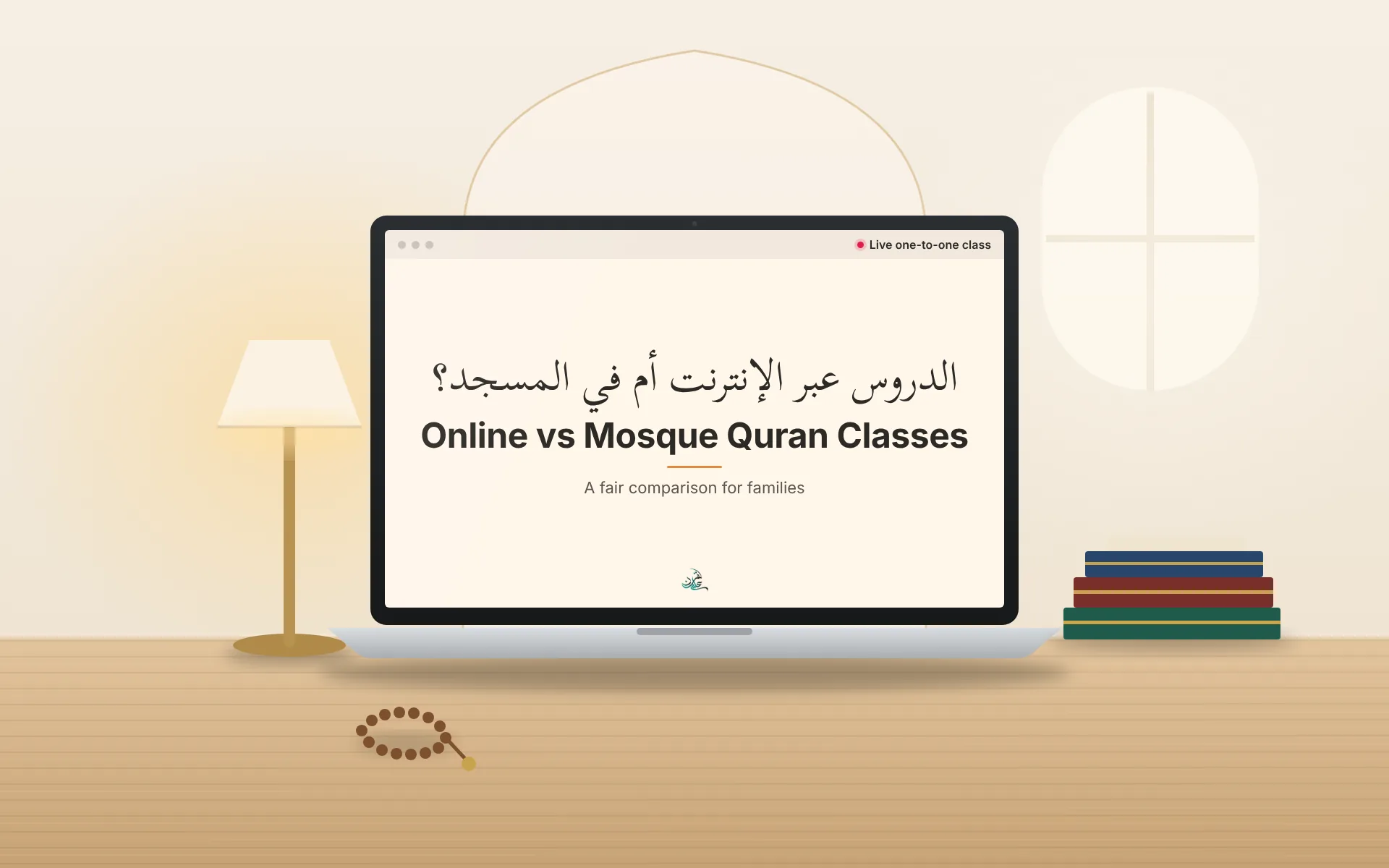
Online vs mosque Quran classes — guide title on a laptop at a home study desk
Both have real benefits. Many families use one for reading practice and the other for community.

Who this guide is for

  • Parents choosing a first class

    You are weighing a local option against online lessons.

  • Children who are falling behind

    Your child needs more attention than a busy group allows.

  • Busy families

    School runs and work make fixed evening classes hard.

How to decide

  1. 1List what matters most: community, cost, progress speed or flexibility.
  2. 2Check what local classes are available, and how many children each teacher has.
  3. 3Book a free online trial class to compare teaching side by side.
  4. 4Choose one, or combine them for the best of both.

Side-by-side comparison

A general comparison. Individual mosques and academies vary.

Mosque or madrasa class

Teacher attention
Shared across a group
Schedule
Fixed days and times
Travel
Drop-off and pick-up
Community
Strong peer and masjid connection
Teacher choice
Whoever teaches the class
Cost
Often low or donation-based

Online one-to-one class

Teacher attention
Full attention for one learner
Schedule
Agreed around your routine
Travel
From home
Community
Limited; add family or masjid activities
Teacher choice
Male or female teacher where available
Cost
Monthly plan; free trial first

If your child is happy at the mosque but reading slowly, two short online classes a week can add focused practice.

What mosque classes do well

A local class connects children with the masjid, other Muslim children and the wider community. That sense of belonging is valuable and hard to recreate online.

Many mosque classes are low cost and run by dedicated volunteers and teachers.

What online one-to-one classes do well

In a private class, every minute is spent on one child's reading. The teacher hears each mistake and corrects it straight away, which is the heart of learning Tajweed.

Families also save travel time, and can request a male or female teacher. Lessons are scheduled around school, work and time zones.

Safety and supervision

Whatever you choose, ask how teachers are checked and supervised. For online classes, keep the device in a shared family space and stay nearby for young children.

At ilmulQuran, teachers are managed and supervised, and families can sit in on classes.

  • Device in a family room
  • Parent nearby for young children
  • Know who the teacher is
  • Ask how classes are supervised

Combining both

Many families keep weekend mosque school for community and add two or three short online classes during the week for reading and Tajweed.

This mix often gives children steady progress without losing their local connection.

Common questions

Are online Quran classes safe for children?

They can be very safe when the academy supervises teachers and parents keep the device in a shared space. Ask any academy how classes are supervised.

Will my child stay focused online?

Most children focus well in short 30-minute one-to-one classes, because the teacher interacts with them the whole time.

Is online cheaper than a mosque class?

Mosque classes are often cheaper or donation-based. Online one-to-one classes cost more but give full teacher attention.

Can my child do both?

Yes. Many families combine weekend mosque classes with short online lessons during the week.

How do I try online classes?

Book a free trial class. The teacher checks your child's level and you can judge the teaching before paying.

Ready to find the right starting point?

Book a free trial class and we’ll help identify a suitable path for the learner.

Educational guide from ilmulQuran Online Academy.