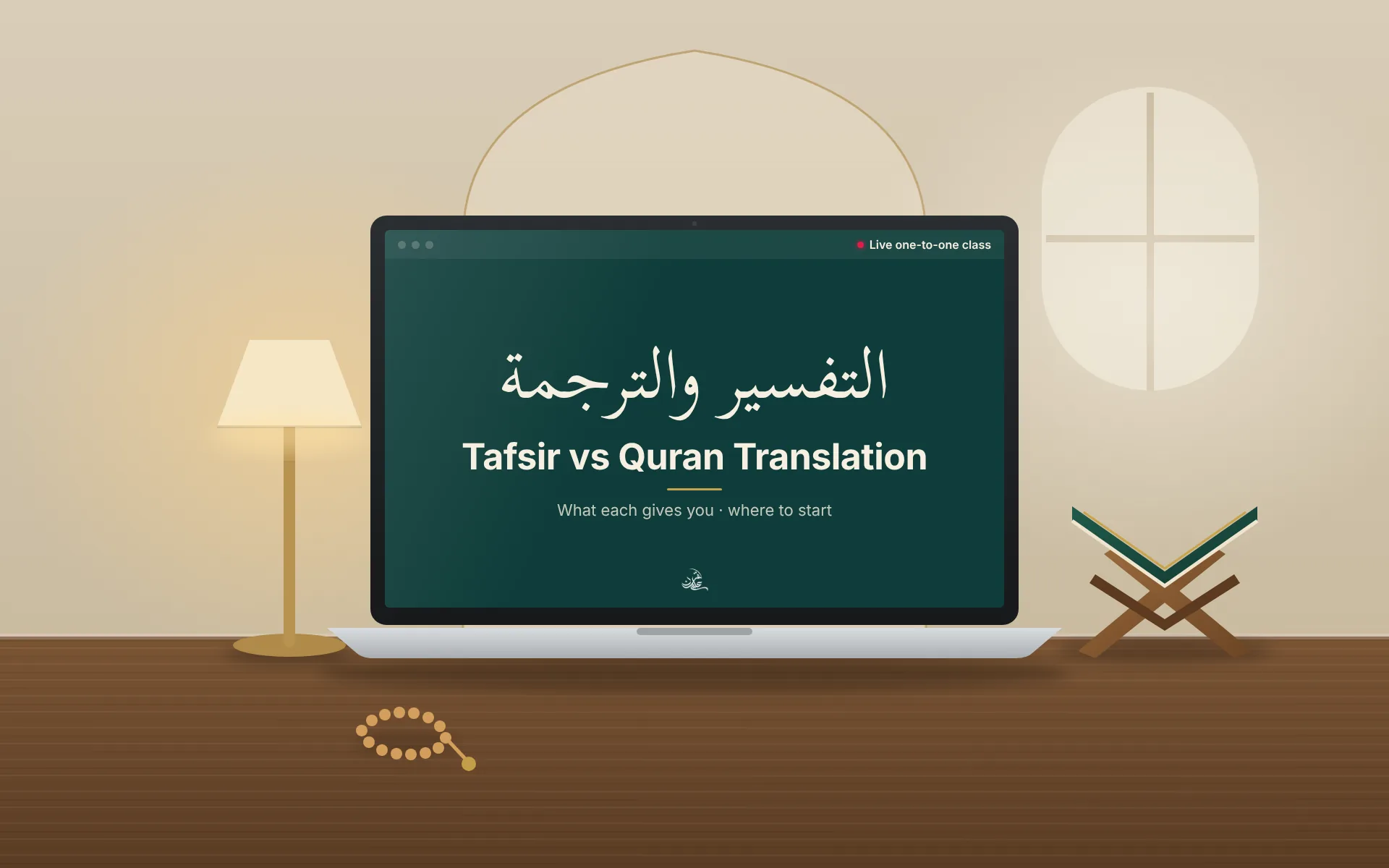
Tafsir vs Quran translation: what is the difference and where to start?
What is tafsir, and how is it different from a Quran translation? A plain comparison of tafsir (tafseer) and translation, and which one to start with.
Live one-to-one classes
Educational, not fatwa
Starting point confirmed in a free assessment
Clear next-step course pages
Translation gives the meaning; tafsir explains it.
Who this guide is for
Readers who want meaning
You recite the Quran and now want to understand what you read.
Learners unsure where to begin
You are choosing between a translation course and a tafsir course.
Parents and older students
You want a clear picture before planning study for a teenager or yourself.
Where to start
1Read a reliable translation of a short surah you already recite, to get the overall message.
2Choose one surah to study more closely and read its tafsir, a few verses at a time.
3Note questions as you go and bring them to a teacher rather than guessing.
4Add Quranic Arabic over time if you want to understand the original words directly.
Tafsir vs translation side by side
Both serve the same goal: understanding the Quran. They do different jobs, and most learners benefit from both.
Compare
Quran translation
Tafsir (tafseer)
What it is
The meanings of the Arabic text in another language
An explanation of the verses and their meanings
What it includes
The translator’s rendering of each verse
Context, reasons of revelation, related hadith and scholarly commentary
Length
Short; about the length of the text itself
Often much longer; classical works can run to many volumes
Best for
Getting the overall message quickly
Understanding a verse in depth and in its setting
Good starting point?
Yes, for most learners
Yes, once you want deeper study, ideally with a teacher
Quran translation
What it is
The meanings of the Arabic text in another language
What it includes
The translator’s rendering of each verse
Length
Short; about the length of the text itself
Best for
Getting the overall message quickly
Good starting point?
Yes, for most learners
Tafsir (tafseer)
What it is
An explanation of the verses and their meanings
What it includes
Context, reasons of revelation, related hadith and scholarly commentary
Length
Often much longer; classical works can run to many volumes
Best for
Understanding a verse in depth and in its setting
Good starting point?
Yes, once you want deeper study, ideally with a teacher
No translation captures every layer of the Arabic. That is one reason scholars wrote tafsir.
What is a Quran translation?
A translation expresses the meanings of the Quran in another language. Many scholars prefer the phrase “translation of the meanings” for this reason.
The Arabic text is the Quran itself. A translation is a human effort to convey its meaning, so wording varies between translators.
A translation is quick to read and gives you the overall message. It is an excellent first step for most learners.
What is tafsir (tafseer)?
Tafsir is the explanation of the Quran. You will see it spelt tafsir or tafseer; both refer to the same thing.
A tafsir explains what a verse means and how it was understood. It draws on several sources.
Other verses of the Quran that explain the passage
Reasons of revelation: the events a verse was revealed about
Related hadith of the Prophet ﷺ
Explanations from the Companions and later scholars
Notes on Arabic language and wording
Well-known classical tafsir works
Scholars have written tafsir for centuries. Tafsir Ibn Kathir and Tafsir al-Tabari are two well-known classical examples.
Classical works are detailed and can feel heavy for a beginner. A teacher can help you approach them a few verses at a time.
Which should you start with?
Most learners start with a translation. It gives a feel for the whole Quran and its main themes.
Move to tafsir when a verse raises questions, or when you want to study a surah closely. Short surahs are a good place to begin.
If you want to understand the Arabic words themselves, Quranic Arabic study works well alongside both.
Common mistakes when starting
Go slowly and keep a notebook. A few verses understood well are worth more than many pages skimmed.
Treating one translation’s wording as the only possible meaning
Drawing rulings from a single verse without tafsir or a teacher
Starting with a long classical tafsir and losing momentum
Reading quickly without pausing to reflect or ask questions
Studying translation and tafsir online
At ilmulQuran, classes are live and one-to-one. Lessons are 30 minutes, two to five times a week.
Male or female teachers are matched where available. We begin with a free assessment, and an optional trial can be arranged.
Fees are listed on the fee and schedule page. We do not promise outcomes, timelines or certificates.
Our classes are educational. They explain meaning and context but do not give fatwa. For rulings on personal matters, please ask a qualified scholar.
Common questions
What is tafsir in simple words?
Tafsir is an explanation of the Quran. It tells you what a verse means, the context it was revealed in and how scholars understood it.
Is tafsir the same as tafseer?
Yes. Tafsir and tafseer are two English spellings of the same Arabic word. Both mean explanation of the Quran.
Is a translation enough to understand the Quran?
A translation gives the overall message and is a good start. For deeper understanding of particular verses, tafsir adds context a translation cannot carry.
Is there a free online Quran tafseer course?
Free lectures and texts are available online and can be helpful. A one-to-one class adds structure and a teacher to answer your questions. Fees are on our fee and schedule page.
Do tafsir classes give religious rulings?
No. Our classes are educational and explain meaning and context. For rulings on personal matters, please consult a qualified scholar.